Tuesday, May 12, 2026

Brain Retraining, Three Years Later

Photo of me laying in bed with eyes closed, one of my cats sleeping across my chest.

Afternoon naps were a necessity,
just to function the rest of the day

I've been reflecting recently on how, just 3 years ago, my health had hit a personal rock bottom: a diagnosis of ME/CFS the year before helped explain why I spent most of my days in a brain fog; why I could barely make it through a 35-hour work-week without crashing; why someone's cologne could render me couch-bound for 2 days; why I could go for a gentle 30-min walk, but not a gentle 60-min one; and why my digestive system had stopped tolerating all but about 5 foods. The diagnosis helped explain those experiences; but it didn't make living through them any easier.

Photo of me with two colleagues (their faced blurred for privacy); I am standing in the middle and while I smile, the MECFS shows in how skinny I have become.

Always slender, I lost a concerning amount
of weight as food intolerances grew

As I learned everything I could about the disorder, I read that some people recover from ME/CFS, some plateau at a reduced level of functioning, and some slowly continue to get worse. Which cohort was I? Was I getting worse? Would I stabilize? Could I be one of the ones who recovered?

Turns out I could.*

The more I learned about ME/CFS, the more I noticed an increased recognition by experts that the disorder is caused by a nervous system stuck in a stress response--i.e. chronic fight/flight. Recovery required calming the nervous system.

And I felt like I had been taking that to heart: increased time spent in meditation, mindfulness, and nature; reducing my hours at work; reducing screen time; regular acupuncture and massage; yoga; a therapist with specific training in nervous system regulation; reconfiguring my Airbnb to be even more of a self-operating machine; breath work and vagus nerve exercises; maintaining hobbies and social connections to the best of my ability...

Photo of me at an orchid fair, where I won some awards in a photography competition. I smile at the camera while pointing to one of my winning images; my smile looks tired.
You can see the fatigue in my face.
Even the things I loved drained me.
While necessary, these habits and practices didn't seem to be sufficient. For me, something was still missing.
 
It turned out to be brain retraining. 
 
Through a few different people, I had heard about the Dynamic Neural Retraining System (DNRS)--a brain retraining program that promised to re-wire the neural connections in my brain that were keeping my nervous system stressed out.** Looking around at the view from rock bottom, I thought, sure, why the hell not? If it can alleviate even some of my symptoms, maybe I could at least manage the others better.
 
And in June of 2023, I began. 
  • After two weeks, I stopped needing naps.
  • After one month, scents and chemicals no longer immobilized me.
  • After eight months, I could do physical activity at a typical level for someone my age.

Panoramic photo of the Rocky Mountains from the top of Sunshine Meadows.

The hike to this view shortly after starting DNRS did lead to a crash--
but it was half as long, and I haven't crashed since

 
Photo of me hanging on a zip line in harness and helmet, arms extended outwards, with a large smile on my face.
Zip-lining in Costa Rica;
8 months after starting DNRS
These days, I sometimes find myself in the middle of an activity--swimming laps at the pool, pulling weeds from the garden, baking or batch-cooking--still in a measure of awe at what my body is able to do today. 

The brain-retraining I embarked on was definitely a catalyst in my recovery. However, it wasn't the only factor; and, I think it can be misleading to imply that any one thing can heal a person. When I was an active member of the DNRS forum, there were many who wrote about brain-retraining being the thing that saved them. However, what has been emphasized in any training or work I've done that's revolved around the brain and nervous system, is that healing happens in relationship. Sometimes that includes the relationship with yourself, but also the others who support you along the way--like others in an online forum, for instance; not to mention family, friends, and medical or mental health professionals. I think it can actually be dangerous to say that any one thing--brain-retraining or otherwise--is a cure-all; however, given the boost DNRS gave to my own nervous system, I get why a person might feel that way.

Top down photo of me sitting at my back yard fire pit, with my cat in my lap.
Backyard campfire smoke?
No problem!

For me, I feel like there was a trifecta of support that came together and really helped me gain traction towards recovery. Certainly, the DNRS brain-retraining program was a significant factor. However, before and during DNRS, and even at present, I've been doing the slower, inner work of somatic-based therapy. My therapist is trained in several body-based modalities; the longer I work with her to release stuck traumas, wounds, and emotions, the less I ever want to go back to talk therapy. Talk therapies like CBT have their place; but, the mind and body are so interconnected that we can't simply 'think' or 'talk' our way back to health. Somatic-based therapy has helped continue expanding the capacities of my nervous system, and re-establish authentic attunement to my own body.

Along with brain retraining and therapy, the third important piece for me has been a medication that helps mitigate some of my remaining digestion issues--mostly by boosting gut serotonin levels, where most of the body's serotonin comes from.

Together, those three elements have helped bring my body and mind to a place of regulation and recovery. 

Photo of me standing in a conference room, holding a microphone as I am presenting.
I facilitate workshops for a living.
This was my first conference post-DNRS;
energizing instead of exhausting!
(Photo credit: SGC)

Am I fully recovered? I guess that depends on how you define recovery. A year from the time I started brain retraining, my symptoms had reduced to the point that I no longer met the criteria for ME/CFS--I'm not sure if that's considered recovery or remission, but given that it's a syndrome, and not a disease, I lean towards the term recovery.

That said, I'm still in the process of recovery in terms of gut healing. My repertoire of food has expanded greatly--I now have a handful of foods from each food group, as well as several herbs and spices to make flavours a bit more interesting. That said, I still pack my own meals and snacks for any event where there might be food, and the only restaurants I'm navigating at this point are places like Freshii and Chopped Leaf, where I can custom-create a salad. I take it one food at a time. However, the stress responses my body used to have to these foods is greatly diminished when they are first reintroduced; this tells me I'm doing right by my nervous system. 

Photo of myself and my infinite reflection in mirrors, in a corridor in Amsterdam
Traipsed around Europe for
two weeks; no big deal
Of course, with recovery comes maintenance. The brain-retraining had a strict protocol of regulating practices and visualizations that I did 4 times a day, for a total of an hour a day, every day, for six months. After that 6-month period, there is more flexibility in how to continue with those practices, based on what the person's nervous system needs. I slowly tapered from 4 rounds of practice to 3, then 2, then 1, and one year after starting, I moved away from DNRS rounds as a part of my practice (though I still follow the DNRS protocol with each food I reintroduce).

Still, in addition to the specific brain retraining rounds, the DNRS program is based on five pillars:

  1. Recognizing that one's condition is caused by limbic system dysfunction (i.e. a maladapted stress response)
  2. Identifying and interrupting the thoughts, behaviours, and emotions that are associated with--and exacerbate--the limbic system dysfunction
  3. Creating new neural pathways by completing the DNRS rehabilitation steps (rounds) for the minimum required duration
  4. Incremental training to help the brain remember that what it previously interpreted as dangerous is actually safe (e.g. foods, physical activity, scents, etc.)
  5. Elevating one's emotional state throughout the day

Selfie standing in front of my photography display at the outdoor Art Walk in Edmonton
Selling at an outdoor art market--something I
couldn't have done just two years prior
Most of those pillars will be pillars for life. I've changed some of my habits and routines to live in a way that is more aligned with what my nervous system needs on a regular basis; and my nervous system now takes priority. In my life these days, that looks like:

  • Keeping my reduced work hours for better work-life balance
  • Prioritizing sleep, and honouring my circadian rhythm as best possible (because society sure won't)
  • Regular physical activity--ideally outdoors
  • Connecting to and communing with nature 
  • Less time on screens
  • Boundaries around the way I consume online content
  • Honouring creative desires and pursuits (and not just photography!)
  • Meditation (I'm particularly fond of yoga nidra, and guided visualizations)

Photo of me hiking down a rocky trail in the hills of Montenegro; I am wearing a backpack full of camera gear.

Hiking mountains? Count me in!
(Photo credit: SG)

Sometimes I find myself in the company of others, and I overhear them sharing stories of long Covid, scent sensitivities, bizarre food intolerances, crippling anxiety... and I wonder if they realize they don't need to be stuck there. But there was a time when I thought I was stuck there. And I know everyone needs to come to healing in their own time and their own way. In the occasional instance that it's been appropriate to share a bit of my own journey, I have. And I hope it makes a difference.

And so I share my journey here, too, in the hopes that it will reach who it needs to. You are not alone. And there is a way out.


Photo of me sitting on a garden stool in the middle of my garden, surrounded by sunflowers and poppies and ground cover. I am holding my cat in my arms, giving her a kiss.
This is what healthy looks like


 *And, based on my recovery journey, part of me holds hope that the other two cohorts can recover as well. 

**DNRS is not the only brain-retraining program, though it may have been one of the originals. The others I have heard of--the Gupta Method, and Primal Trust--offer similar outcomes, but with a slightly different focus. As I understand it, DNRS focuses on neuroscience, the Gupta Method focuses on meditation and mindfulness, and Primal Trust focuses on attachment.

Saturday, January 24, 2026

Stairs That Tell a Story: Default Stairs

Location: Ada Boulevard & 52 St.
Stair count: 89

I could be wrong, but it's my belief that anyone who lives in Edmonton, and uses the River Valley trail system with intention, has a set of "default stairs." It may not be their favourite set, or even the one closest to their home or place of work. But, for whatever reason, it's the set of stairs they gravitate to the most, or come across the most, when they are seeking to spend time in the River Valley.

Photo of a wooden staircase leading down into a river valley, in the winter
Highlands Stairs (c) Photos By Gina


For me, it's the Highlands Stairs.* For much of the last 20 years that I've lived within walking distance of this part of the river valley, the stairs never even existed. As far as River Valley stairs go, they're a newer set. I want to say they were installed just before Covid--which really isn't new at this point, chronologically speaking, but between the much longer history of some sets of stairs, and that weird thing Covid did to time, they still feel new.

And I'm so glad they were installed.

They're the stairs I stand on to catch the sunset over the river when I wasn't planning to catch the sunset at all, but the sky had other plans.

They're the stairs where I do Canadian party tricks at -30°C.

They're the stairs from which I watch and listen as the frazil floats along the current.

They're the stairs I pause on to see if the water level is low enough to look for cool rocks along the shore.

They're the stairs I generally descend, but rarely ascend, because my walking habits generally take me in a loop, not out and back.

They're not the longest set; they're not the steepest set; I'm not even sure if they're my favourite set (do I have a favourite set? I will have to think on that). But they are definitely my default set. Easy-access and multi-purpose, they connect me to and from the river, the trails, and my neighbourhood--in all seasons.

My default stairs.


*They aren't officially named that, though some sets of River Valley stairs do have recognized names. But that's what I call them.

Thursday, February 6, 2025

First Impressions of the Fediverse

So, I can confirm that I've landed in some new social media spaces, though I'm still "unpacking," so to speak. And still getting to know the neighbours. I've found my way to the Fediverse, and so far, it's been... refreshing?
  • No ads
  • No algorithms
  • Posts in chronological order
  • Hashtag driven
  • Welcoming and positive 
  • Quieter (in the good way)
  • Broader reach (for profiles set to 'public')*
So, how is this possible? One of the biggest factors is that the Fediverse is decentralized. No one person owns or runs the fediverse

As best as I can describe it, the Fediverse is a network. There are overarching servers (domains?), and then there are a bunch of different servers within that--each run by a different host, each with a slightly different flavour. (If you wanted to, you could start your own server, but if you’re the average person like me, you’ll probably just join one.)

The individual servers seem to be based on region or topic of interest. For example, there is a server on Mastodon called "mastdn.ca" which is tailored to Canadian audiences. There's also "mastoart.social" which consists primarily of art-related posts.

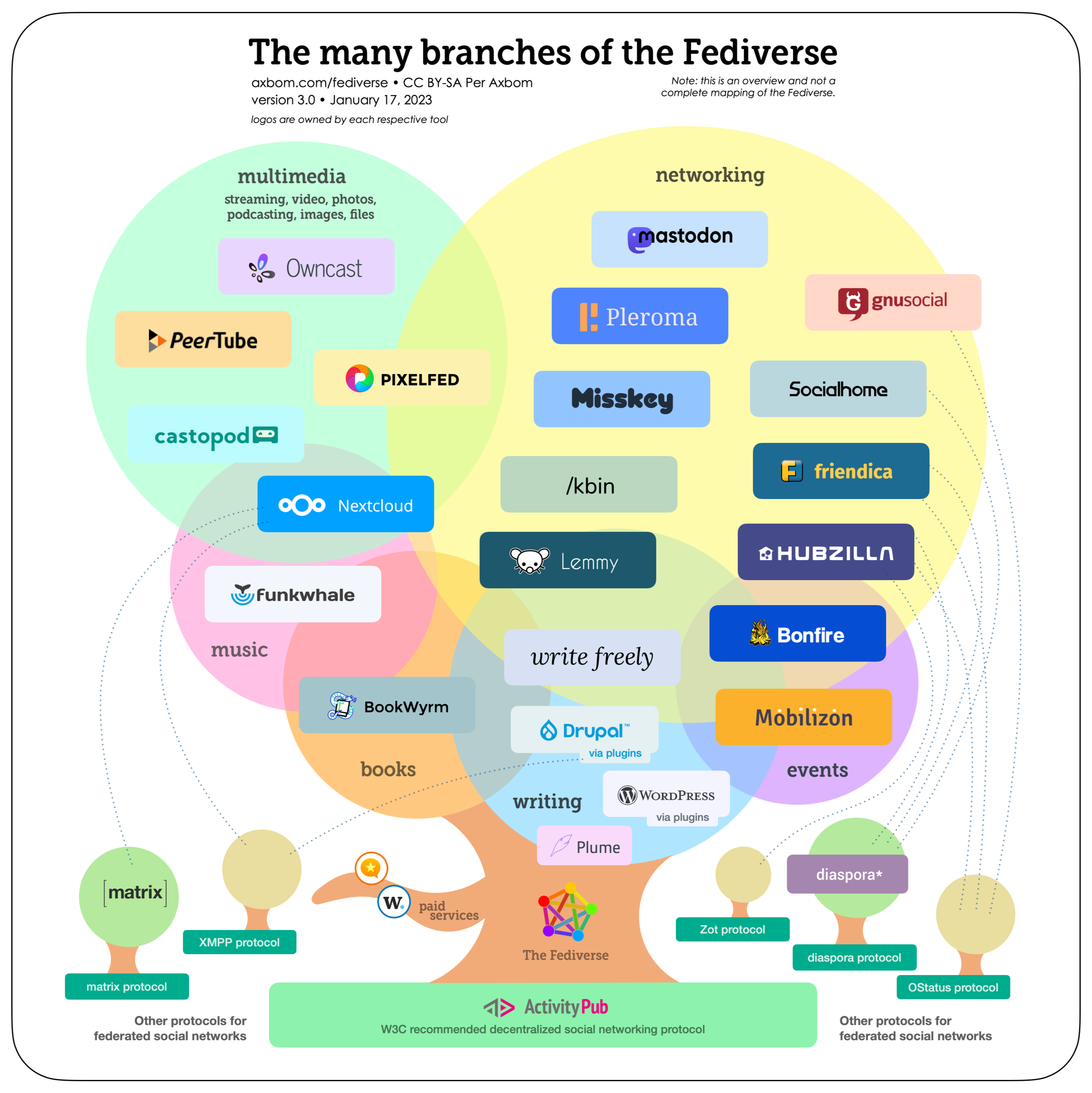
The larger domains also seem to have different emphases in terms of the purpose it serves and the content people can expect (see tree 👇🏻).


The cool thing about the fediverse, is that you and I don’t need to be part of the same server to see each other's posts. I can follow you, and interact with your posts, even if I’m on a server at Mastodon and you're on a server at Pixelfed.

In this way, the analogy of email or even snail mail has been used to help people understand this concept, because it’s definitely different than mainstream social media.

If you think of email, there are lots of different domains: Gmail, Yahoo, Outlook, etc. But even though we may use different email providers, we can still connect to each other. I can connect with you at Hotmail, even though I use Gmail. Post is the same. Each country has their own postal system, but I can connect with you using Canada's postal system, even if you’re in Germany using Germany's postal system, because they're both part of a larger, global network.


Like mainstream social media, you can set up your profile so that only people who follow you can see your content (i.e., private), or you can choose to have it be public, so that anyone can see your posts. 

I'm sure there are 'dark' servers, just like there is the 'dark' web. However, I've found what feel like safe and positive places to set up shop, and for now, I'm here to stay.

Post by @photosbygina_yeg@mastoart.social
View on Mastodon


*In just a couple weeks, I have more followers on my Photos By Gina profile than I did on FB and IG combined over several years!

Saturday, November 16, 2024

If You Give a Girl a Hot Tub...

For my last birthday, I received a City of Edmonton gift card, usable at most of the city's attractions and facilities. Given that it was the dead of winter, I first used it at a rec centre near by, solely to soak in the hot tub

It was glorious.

And so, I hopped around from rec centre to rec centre, checking out the different hot tubs, and the occasional steam room. Once or twice I took a yoga class. But mostly I just liked sitting in the hot tub. 

I found myself coming back again and again to the leisure centre closest to home. It's smaller, older, and therefore tends to be quieter. I started bringing a book each visit, reading while I soaked.

As the weather started to warm up, I found myself one headed to the leisure centre one evening thinking, "y'know, it might feel refreshing to dip in the pool first, before the hot tub."

Now, let me pause here to clarify that I am not a swimmer. In my educator days, I didn't mind playing in the water with the children I was teaching or caring for, but the sport of swimming has never appealed to me. I failed swimming lessons over and over (and over), mostly due to an imperfect front crawl, and a refusal to dive without plugging my nose. But my mom, having seen me tread water (which I could do like a boss), and feeling confident that I could save myself if I fell off a boat, finally took mercy on me and let me stop lessons.

So, when I say I considered a dip in the pool, I quite literally meant a dip in the pool and nothing more. I grabbed a couple pool noodles, put one under my knees and one under my arms, and floated around on the small waves made by other swimmers.

After a few weeks of this, I figured "y'know, since I'm already in the pool"--and since the novelty of the  new energized version of me was still mesmerizing--"I might as well do some aqua-jogging." And so across and around the pool I went, moving to the beat of whatever playlist the lifeguards had chosen.

Faces around me started becoming familiar; I realized the pool had "regulars," and that I was becoming one of them.

One evening, the pool was unusually crowded, except for the area sectioned off for lane swimming. And I thought, "y'know, since I can do so much aqua-jogging, certainly I could do a length of lane swimming." There aren't many swimming strokes I care for, but I do have a fondness for the backstroke when the situation calls for it.

And so I pushed off from the wall, the water just covering my ears, so that the 80's music around me faded, and all I could hear as I followed the line on the ceiling was my rhythmic breathing; it was nice.

Over time, one length turned into two, two turned into three, three turned into four.

And I thought, "y'know, snorkeling might be kinda fun." Snorkeling definitely draws one's focus to the breath. And I also remembered how, the few times I'd snorkeled on holidays, I'd found the act of swimming to be easier and more enjoyable.

And so I bought a snorkel.

And what started as just a soak in the hot tub has become a mix of self-guided aquacise, lane swimming, and snorkeling. ...Though,
definitely still a soak in the hot tub.

Tuesday, February 20, 2024

Pura Vida

"Pura Vida...it's Costa Rica's slogan, as well as being a way of life. The direct translation is "pure life" but it's so much more than that. It's living the good life...cherishing simple pleasures...spending time with loved ones...and enjoying a slow, relaxed pace of life." 
- John Michael Arthur

Pura Vida is a phrase I heard or said myself several times daily in the beautiful country of Costa Rica, where I just recently returned from after two weeks' vacation. Costa Rica has been on my “must see” list of places to go for several years. Warm, tropical, known for being eco-conscious, lots of flora and fauna to photograph… It had been over 10 years since my last tropical vacation, and it felt very overdue!

One highlight of this particular holiday was how thoroughly I was able to enjoy it, physically as well as emotionally. I enjoyed the company of good friends, watched the sunset on the beach every evening, ate nearly every meal outside, floated in the pool with a good book, won a card game or two...

Balancing out the gentle, unhurried pace, were also a variety of activities for the senses, including:
As well as the sights, sounds, and smells of a foreign country; all in 30°C+ temperatures; none of which required so much as a nap afterwards.

This would have been a very different trip even a year ago. There would have been resting the full day before and after any activity, and lots of negotiating with myself about which activities might be ‘worth’ that.* I would not have done nearly as much sight-seeing. Just the daily trekking around in the golf cart (our rented mode of transportation) would have been enough of a sensory experience to tire my brain and body for the remainder of the day.

Instead, I was able to enjoy every aspect of my holiday, fully present through it all.

I am SO proud of my nervous system, and I’m proud of myself as well. I’ve done a lot of work to get to this point.

The view from my bedroom balcony
where I did my brain retraining
each day
I continued my brain retraining practices each day in Costa Rica—delighting in the ability to do my 'rounds' entirely outdoors! After 8 months, my rounds have become as routine as many people find the gym.

Now that I’m past the 6-month mark, I’ve been playing with the frequency of my rounds, weaving back in more of the other practices I’m familiar with and have come to enjoy (e.g. yoga, breathing exercises, meditation). At the very least, however, I’m finding my rounds are a nice way to start and end my day.

Especially with palm trees as my backdrop and tropical birds as my soundtrack.

My first spark of hope with my recovery came last summer when, just two weeks into my brain retraining, I realized I hadn’t needed a nap in several days. As I regain the ability to do more and more of the things I love well--like travel--my hope grows. When I have hiccups, I know they’ll pass; and, they are fewer and farther in between.

I was fortunate enough to vacation in the Nosara area, which is on the west coast of the Nicoya Peninsula, one of the world's Blue Zones. Immersed in sunshine, ocean waves, and tropical jungle, it's not hard to see why it's a Blue Zone. This vacation was not just a boost to my nervous system, but a boost to my spirit as well.

Pura vida.


*There is a huge difference between resting because I want to, and resting because I have to.