Showing posts with label awareness. Show all posts

Friday, May 12, 2023

Mystery Unfolding

It's interesting to consider that today is ME/CFS Awareness today, as it was a year ago--almost to the day--that I reached my breaking point in this health journey. 

After four years of increasing symptoms, I had not yet been diagnosed. I was recovering from a 3-month-long GI flare that had caused a lot of pain, fatigue, and left me intolerant to even more foods than I had been previously. More often than not, I was headache-y; brain-foggy; nauseated, bloated, and crampy; I was itchy; I was in pain; and I was oh, so tired.

My mental health was not faring much better at that point. I'd been screened and tested for all the things. But having a bunch of tests come back "normal" didn't fill me with relief--I felt anything but 'normal'. Various professionals tried to chalk up some of my symptoms to stress. Of course I was stressed! I was trying to live a life that felt very uncertain, in a body that felt like it was retaliating against me. Sometimes I just wanted to scream, NO! Pay attention! Something is wrong inside me!

But if doctors didn't know what it was, how could they take care of me? How could I fully take care of myself? Was I doing things to make my health worse without knowing it? Was this something life-long, or temporary? Would the day's symptoms interfere with my activities or just simmer in the background? Should I be taking time off work? How would I even advocate for that with a mystery diagnosis? What if it really is all in my head? What if I can't afford this health issue?

I felt like I was being consumed by this thing I didn't even have a name for. 

I had attended a webinar for work a few weeks prior, which included some discussion around mental health. They shared something called the Stress Continuum, shown below.


I was already familiar with the "surviving and thriving" dichotomy. I knew I'd spent much of the last several years 'surviving' (pandemic notwithstanding). And I knew I was feeling particularly rough at that point in time. But this was the first I'd seen that what I was experiencing was not just 'rough' surviving, but that I was camped out in Struggle.

Something hit different seeing everything I'd been experiencing for several months listed so straightforward in the yellow column. "I really can't keep this up" I whispered to myself.

I had a friend offer some wisdom and empathy, and when I limped into my scheduled therapy appointment two days later, it didn't take much of her own wisdom and empathy for me to unravel.

This was rock bottom.

Now; you know how some of the story has progressed. It's amazing the relief and insight a diagnosis can bring. It provides the ability to access and implement relevant treatment strategies; find a community of people with shared experiences to learn and grow with; and interestingly, I've received less of the well-meaning, but often useless, "have you tried...?" comments.

I'm focusing on this aspect of my health journey today, because I think as much as we need to be aware of the disorder itself--to find better prevention, treatment, and recovery strategies--it's important to be aware of the individual's struggle leading up to this particular diagnosis. 

@trishagreenhalgh
ME/CFS is not the only medical condition out there that is tricky to diagnose. But I would argue it's one of the more maleficent conditions, in that there are no clear tests for it (i.e. you won't find lesions or antibodies), and doctors receive very little training on the condition. Indeed, it never crossed the minds of my GP or the 6 specialists I'd bounced around to (or the myriad of integrative health professionals I work with on a regular basis). There are some who still hold onto the stigma from the 80's that it's not a "real" condition, or that it's psychosomatic at best. However, the CDC recognizes it as a neurological disorder, and while there are no specific tests to diagnose ME/CFS, there are patterns and indicators that show up in those with that diagnosis significantly more than other conditions or the general public (the PEM and the mitochondrial dysfunction, for starters).

In many ways, I am fortunate. My condition was 'caught' early. My protective factors, self-advocacy, and various forms of privilege are likely what kept me from moving into Crisis on the continuum.*

Others are not so fortunate.
  • There are some who go much longer without a diagnosis than my four years.
  • There are those with much more severe degrees of ME/CFS who are consumed by depression or anxiety (or both).
  • There are many for whom it's not safe, affordable, or otherwise possible to keep coming back to their doctor and demanding the next option for answers.
  • There are some who are never taken seriously by any doctor.

My understanding is that the tides may slowly be turning, thanks to Long Covid. There is increasing evidence that Long Covid is ME/CFS. Approximately 80% of people with ME/CFS develop the condition after a viral infection. Many with Long Covid meet the criteria for an ME/CFS diagnosis; it's likely that Long Covid just happens to be ME/CFS where the specific virus is known. And because of the nature of Covid, the medical field is taking Long Covid seriously,** which means hopefully those with non-Covid-related ME/CFS will start to be taken more seriously too.

Until then, I guess we continue our efforts to make the invisible visible, to get the medical attention we deserve, and in a timely fashion, and to advocate for better.

I do hope that you who are reading these posts are internalizing the knowledge and stories I am sharing. And I hope you will be an ally to those with chronic conditions--particularly the nebulous ones like ME/CFS, fibromyalgia, Long Covid, MCAS, etc. In the same way that marginalized groups of people find themselves having to do the work of educating the privileged when they shouldn't have to, the same often holds true for those with chronic illness. Certainly because of my value of learning, I choose to do this to a certain extent. However, I get tired easily, and there is strength in numbers.

How could you help someone around you who might be Struggling today?


*Thought I dipped my toe into crisis when I contracted Covid. Covid made my ME/CFS symptoms ten times worse, and hit when I was still trying to climb out of that rock bottom place. While I did not consider hurting myself, I could start to understand why those who live with more severe ME/CFS sink into deep depression, or consider ending their life.

**Though, given how blasé the world has become about the short and long-term effects of Covid, I still sometimes wonder if they're taking it seriously enough. 

Monday, May 1, 2023

Becoming Aware... of Spoons

May is ME/CFS Awareness Month. I'm sure it's an awareness month for a bunch of other conditions and causes, but this one is extremely personal, so I'm gonna take it and run with it. It seems so strange to talk about awareness for something I’m aware of every waking moment (and sometimes even in sleeping moments; this damn disorder has infiltrated my dreams on more than one occasion). 

But I would guess that is always the way for the person living with the thing for which they are trying to make others aware.

"Aware is half way there," it has been said; yet, I also feel there needs to be so much more than just awareness of any given cause, disorder, disease, injustice, etc., to move the needle on change or to make amends for damage done. (Hold that thought; I'll come back to it in time.)

May 12 in particular is International ME/CFS Awareness Day. Actually, that day isn’t solely about ME/CFS. It’s the International Awareness Day for several disorders that fall under the umbrella of nebulous multi-systemic neurological or immunological conditions—ME and its cousins, like fibromyalgia, multiple chemical sensitivity... These disorders are common, yet so poorly understood, that they get lumped together.

I guess we really do need to focus on awareness.

I wrote a post last year explaining a little bit about what ME/CFS is, so if you're entirely new around here, or want a refresher, pause for a moment and check that out, or check out the CDC's definition.

There are many facets to ME/CFS, too much to focus on in one post. Today, I want to shed some light on the 'fatigue' part. ME/CFS is one of many chronic illnesses that are considered "energy-limiting." Yet, the 'fatigue' part of "Chronic Fatigue Syndrome" has been so misunderstood and misinterpreted. It's not just just that we need a nap, or a couple good nights' sleep. ME/CFS involves mitochondrial dysfunction. You may recall from high school that mitochondria are responsible for making all the energy your body needs and uses. Well, my mitochondria no longer make energy efficiently. So that means it's hard to have the energy I need to do the daily tasks of living, working, and socializing; and, it's hard for my body's internal processes (digestion, cognition, circulation, etc.) to function at full capacity.

Sometimes I've compared my daily experience to that of being an old cell phone with a battery that drains too quickly, and doesn’t seem to charge properly. It’s as if I’m forever closing power-heavy apps, dimming the screen, and enabling low-power mode, just so I can text my friends.

I just finished a book that uses currency to describe the energy you have to "spend" each day (no overdraft or loan or credit card options, by the way).

Others have described it like a vehicle--there is only so much fuel (and there seems to be a leak somewhere).

However, one analogy that seems to have struck a chord in the chronic illness community is “Spoon Theory.” It’s not actually a theory, it’s an analogy, but stick with me. The creator of this analogy uses spoons to represent energy. Essentially:
  • Everyone wakes up with a quantity of spoons; healthy people wake up with [a lot] more.
  • Every task you do, and every experience you engage in, requires a certain number of spoons (FYI, healthy people use less spoons for the same task as someone with a chronic illness).
  • If you run out of spoons before the end of your day, you’re in trouble.
  • While most people’s spoons magically replenish in full during sleep, that’s not a guarantee for those with ME/CFS (or other energy-limiting chronic illnesses). It’s more than likely we will replenish some spoons, but the number varies from day to day. Yesterday I woke up with 10; today maybe only 6.
Turns out, this analogy resonated in the chronic illness world, and begat a term for people who have to count their spoons carefully--Spoonies. (I'd seen the term Spoonie used on disability-related social media posts, but never really understood what it meant. And then suddenly I was one.)

As you start—or continue—on your awareness journey with me this month, I invite you to take 5-10 minutes to read more about Spoon Theory by clicking the meme below.*


Sunday, October 16, 2022

Aware of the Invisible

I recently learned that this week is Invisible Disability Awareness Week.

I have mixed feelings about awareness weeks. Awareness is great, but sometimes I feel like it doesn't move the needle just by being aware that certain disabilities, illnesses, or stigmas exist in the world. And yet, as was stated more than once in a course I took on implicit bias: "aware is halfway there." So maybe there's something to it.

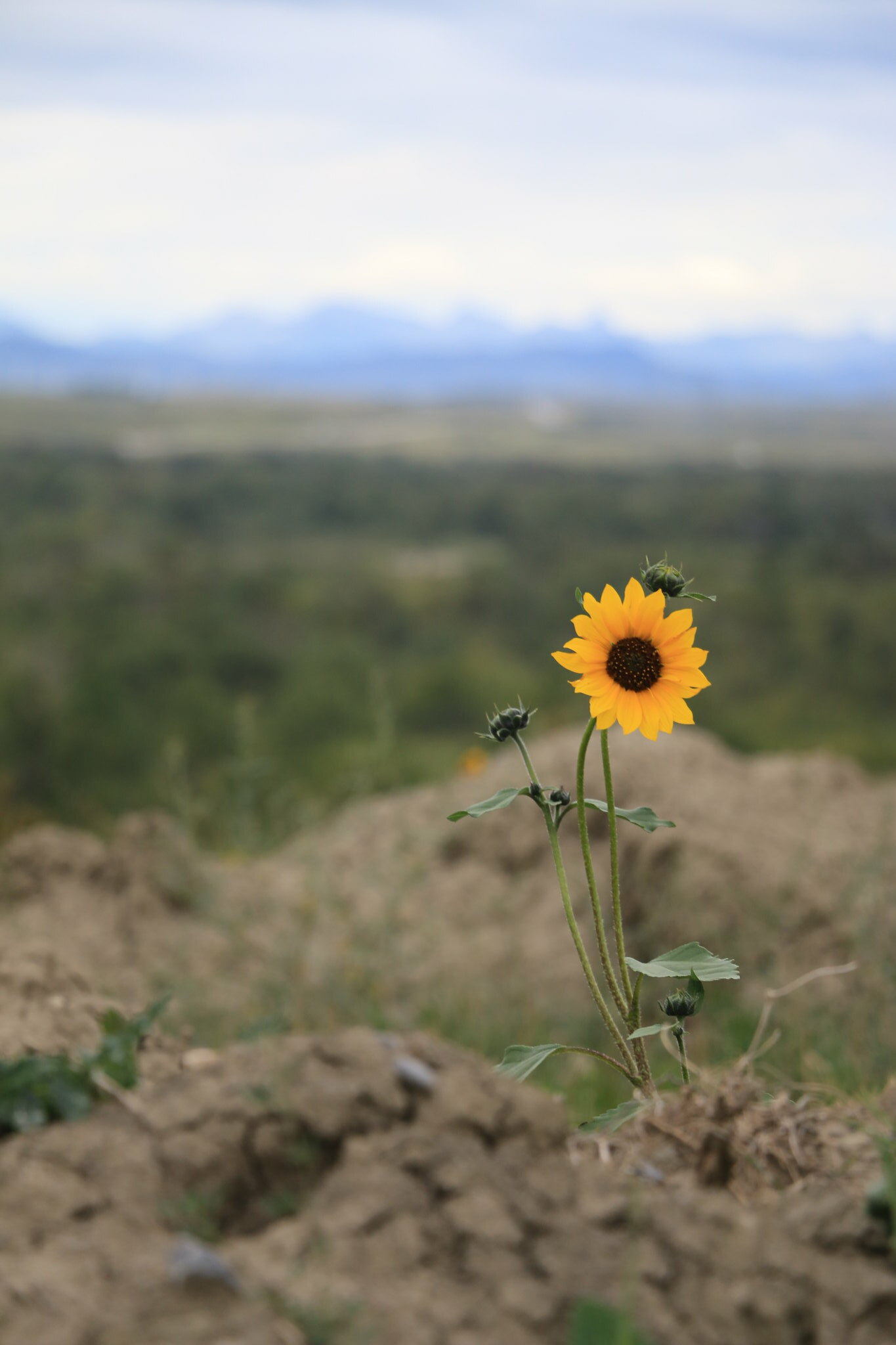
A sunflower grows from a pile of dirt; the only flower visible. To me, flowers growing where they shouldn't is a symbol of resilience.
(c) Photos by Gina
Coincidentally, this awareness week is the same week I am taking a photography course in Oregon. Last year, I took the instructor's course in Nevada. It was great! And, I was exhausted most of the time. In hindsight, I can see that I was crashing. Too much stimulation, too much exertion, too much excitement (and too much jumping).

I had confirmed my trip for this year shortly before I was diagnosed. Once I started to understand how my body was using energy, I searched the internet for travel tips. It was interesting to see some of the things I'd already started doing in recent weekend trips to support my own well-being. Clearly, I listen to my body more than I give myself credit for.

I've put some additional strategies in place for this trip--gleaned from others who've gone before me--in the hopes of mitigating the post-exertional malaise. Some of these strategies are as invisible as the disability itself; others will make it more obvious that I don't go about some tasks like others do.

I'm not so sure it's awareness I'll need as much as empathy.

One cool thing I discovered in an ME/CFS support group is the Hidden Disability Sunflower Program. Increasingly, businesses around the world--and airports in particular--are recognizing the sunflower as the symbol of invisible disability or illness. A visual prompt for awareness and empathy, as it were.

All four airports I will be travelling through are part of this program.

[Insert sigh of relief here.]

I have a lanyard that I'll be wearing, as well as sunflower stickers on some of my belongings, that I'm hoping will--as their website says--"make the invisible visible."

We'll see how it goes. 🌻

Monday, May 20, 2019

Aware

I caught in my Twitter feed the other day that the High Level Bridge was being lit up for Food Allergy Awareness Week. My eyebrows furrowed; there's a Food Allergy Awareness week? (Of course there is.)


I've become more aware of food allergies and sensitivities recently than I ever wanted to become. Something in my system short-circuited last year, and I now find myself allergic to gluten, dairy, egg, and soy. ...Plus a handful of intolerances on top of that.*

So when it comes to food these days, I'm aware of everything.

I'm not quite out of the woods yet in this journey, but I'd like to share a little bit of what I've learned with you. Let you into a bit of my reality. Because increased awareness of any cause or condition doesn't just come from lighting a bridge in pretty colours. It comes from the shared stories of the people who live the experience.

I am fortunate that my new "health condition" isn't debilitating or life-threatening. But it is chronic. And nevertheless life changing. My heart breathes a sigh of relief when I hold out my laundry list of allergies and am met with empathy.

May this shed light on how you might be that person to others as well.

So. Some thoughts on [my] food allergies in no particular order:


No, I can't cheat.

Allergies are an immune response. Every time I consume an allergen, it stresses out my immune system, thus putting my health at risk. Also, just because my allergies aren't life-threatening doesn't mean they don't make me uncomfortable. Stinging and watery eyes, congestion, heartburn, headaches, shortness of breath, lethargy... sure, that sounds like tons of fun; said no one, ever.

The intolerances are, in their own way, worse. With those, some foods don't get broken down like they should. Worst case scenario, molecules run the risk of passing through my intestines into my body and blood stream not fully metabolized--which could seriously damage my gut over time. Best case scenario is the molecules bypasses digestion and land in my colon, where they are glutted upon by my gut flora, causing uncomfortable bloating and/or socially embarrassing flatulence** for up to twelve hours.

So no, I'm not going to cheat.


No, there's no going back.

I've had people ask if I'm back to eating regular food yet. Here's the thing: I likely won't ever be going back to "regular" food. With the support of a registered dietician, I went through a rigorous elimination and reintroduction process.

But unlike so many eliminations these days, mine was not a fad cleanse.

It was a test.

Most foods passed the test. Several did not. And while allergies can disappear, my understanding is that it's more often the case with childhood allergies that people outgrow. Not sure how long it would take to "outgrow" allergies that start in one's late 30's, but I'm betting it's not anytime soon.


You're right, it is expensive.

I have heard the lament of those who are required to occasionally purchase allergen-free food for someone they know (I used to be one of those people). "Do you know how much it costs to buy the gluten-free kind?" Yes, yes I do. I pay nearly twice as much for 3/4 the amount of food than I did in my pre-allergy life. I also now shop at three different grocery stores, just to have the same variety in my food choices as those without allergies (no store seems to want to carry the same allergen-friendly brands as others; what is up with that?).

It takes extra money, time and energy, just do to the groceries. Consequently, if you are one of the people who have gone out of their way to buy or make me a Gina-friendly snack or meal, know that I absolutely love you.


Eating out sucks.

There is no clearer way to put it than that. For one, I now run the risk of coming across as "that person" with my litany of questions for the server, and the double-triple-checking I make them do. Turns out self-advocacy takes effort and courage--every single time.

In terms of actual eating, the only restaurants I have found--yet--where I can eat with 100% confidence is Freshii and Chopped Leaf, because I can make a custom salad.

But, you guys.

I am so. tired. of salad.

It seems to be all I can order in any mainstream restaurant. And even then, I generally need 2-3 ingredients removed or substituted. I am a salad connoisseur these days; not a title I ever anticipated having.


Travel is stressful.

Because of that eating out thing.

I am so grateful to live in a large urban area where I have at least half a chance at restaurants, as limited as my options may be. Cities also afford access to alternative-style restaurants that cater to diverse dietary requirements (I still have to modify whatever I order, but I feel less judged there. As well, staff at alternative restaurants seem to thrive on the challenge to make me a safe meal, rather than see it as a burden to have to modify the dish). However, when I travel, it generally involves passing through small towns where the definition of salad is iceberg lettuce with tomato and cucumber. That's not going to sustain me.

And even when I find a restaurant that is willing to accommodate, there is always just a hint of worry--what if they miss something? What if my symptoms are worse than before? It's one thing to experience symptoms and just go home; it's another to be out of province and feel crummy.

I'm a bit of a snack-hoarder these days when I travel; and yes, I do pack breakfast in my suitcase--one less meal to purchase is one less meal to stress about.


There was a grieving process.

It took me about four months to realize what I was feeling, but I've experienced legitimate grief in this whole process. I don't like cooking. While I would sometimes try making new dishes, I relied on a collection of easy go-to recipes, mixed in with the occasional convenience meal (e.g. frozen pizza). In addition to now having to make ev-er-y-thing from scratch, suddenly most of the recipes I'd curated over the last 15-20 years were not even an option.

I grieved the loss of this way of being; this routine; this familiarity.

Even more so, I grieved the loss of recipes that I not only enjoyed, but were associated with memories of being shared with others. I can't share those recipes again.

Unlike cooking, I quite enjoy baking. But still, I had to grieve the loss of recipes made for myself and others that could not be adapted, or did not adapt well when I tried (and oh, I tried). While I have started to find new and successful recipes for baked goods, my baking game is still not quite where it used to be. For many reasons, I am still searching for lost joy in this activity.

That being said...


You don't need to feel guilty about eating different food than me.

Okay, I can't actually tell you how to feel. But please know, I don't feel tempted or jealous, nor do I grieve, as you all eat your Hawaiian pizza with double cheese, and I enjoy herb chicken over rice. It's true, I know what I'm missing food-wise. But I also know what I'm missing symptom-wise. And while I'm still on the hunt for a few good alternatives to favourite dishes (like pizza), I am not lacking for good-tasting food overall. Especially as I can still have wine, and dark chocolate, and bacon...


I'm trying not to talk about it all the time.

Really.

I know it worms its way into the conversation every time food makes an appearance. I know it seemed like it was all that was on my mind at first. It was all that was on my mind at first.

It means a lot that you ask how I'm doing. I'm trying to get better at giving a meaningful but concise update; I'd like to get back to regular conversation around the table too. But for all the gains I've made in a year of trial, error, testing, adapting, changing, it still consumes a large portion of my thoughts and routines.

I don't need a bridge to remind me to be aware of food allergies; I'm never not aware.

I see others who've had adult-onset dietary conditions for much longer than myself, and they seem to engage relatively confidently with food. I know I'll get there. I so appreciate the patience and grace that is continually extended.

There is light at the end of this teal tunnel.

Maybe it's that pizza.


*The intolerances have been simmering for years; they just finally seem to have reached the tipping point.
**Like, I
don't even want to be in the same room as me.